
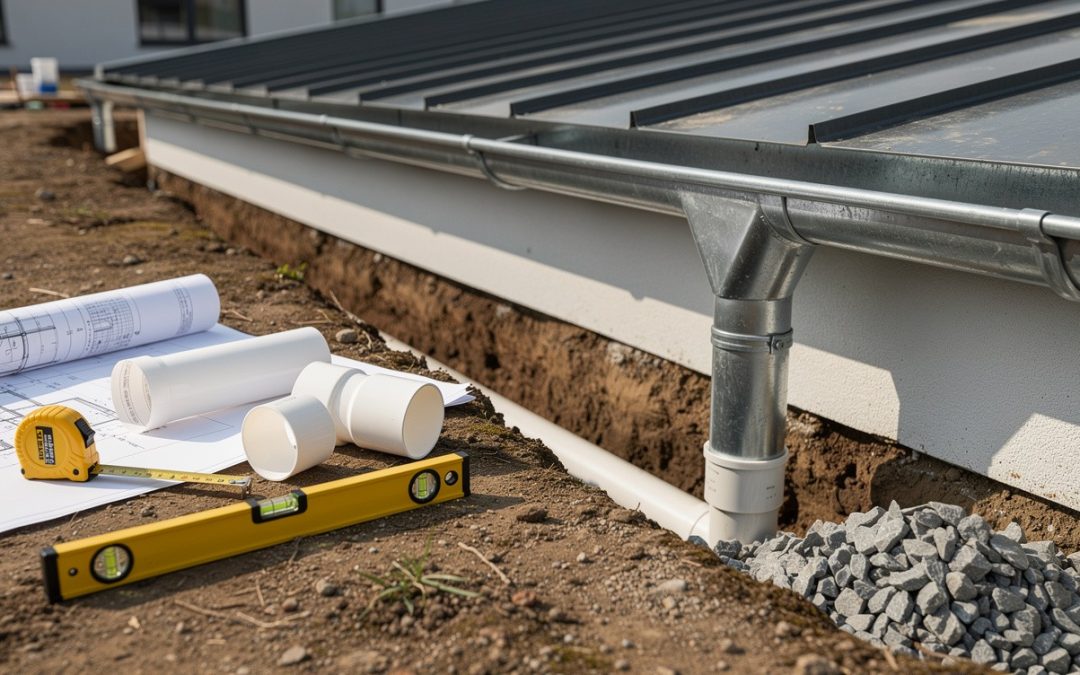
Your gutters are only half the battle. Without proper downspout drainage planning, water that leaves your roof can wreak havoc on your foundation, basement, and landscaping.
At Desert Gutters, we’ve seen firsthand how poor drainage decisions lead to expensive repairs. The good news is that strategic planning prevents most of these problems before they start.
What Happens When Downspout Drainage Fails
Foundation Damage From Concentrated Water
Water that exits your gutters without a plan becomes your home’s enemy. When downspouts dump water directly against your foundation or allow it to pool near your home, you set yourself up for serious structural damage. Foundation cracks develop when soil becomes oversaturated, and once water enters your basement, repair costs climb into the thousands. The average NFIP claims payment to restore damages after a flood is $52,000, making downspout placement one of the most cost-effective decisions you’ll make for your home.
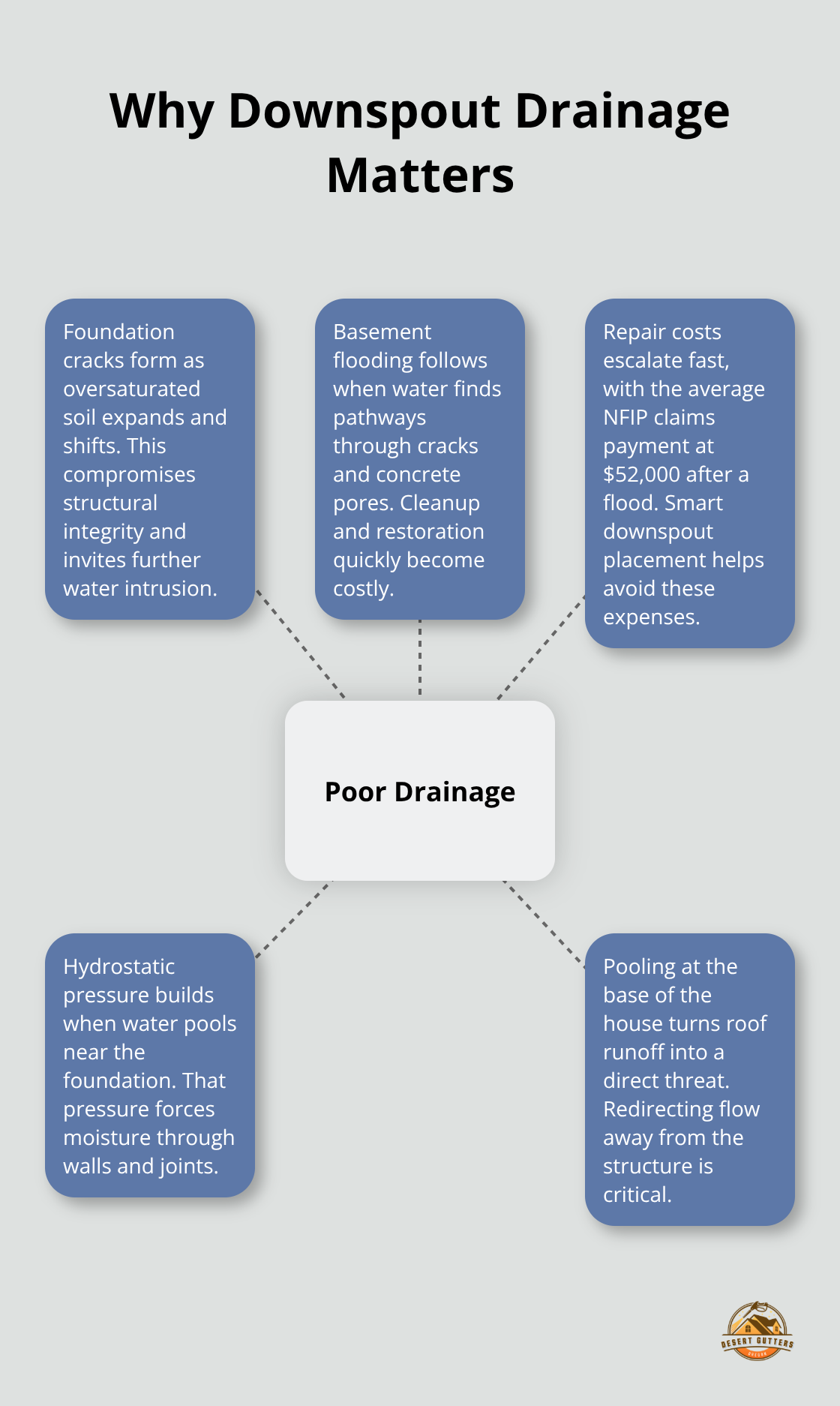
Your foundation needs water directed at least 4 to 6 feet away from the house, and ideally much further if your yard slopes toward the structure. Without this distance, hydrostatic pressure builds against foundation walls, forcing water through cracks and concrete pores. Basements flood not because gutters failed, but because downspouts discharged water in the wrong location.
Erosion and Landscape Damage
Erosion around your home’s perimeter happens faster than most homeowners realize. During heavy rain, each downspout on your home can send up to 12 gallons of water per minute into the sewer system, and if that water concentrates in one spot, it carves away soil and undermines landscaping, patios, and walkways within months. Winter conditions make this worse-water freezing and thawing near your foundation creates expansion that damages concrete and weakens soil stability.
In cold climates, ice dams form when roof heat melts snow that refreezes at the eaves, but poor downspout drainage compounds the problem by preventing meltwater from flowing away from vulnerable areas. The solution requires intentional design: underground downspout systems with proper slope, pop-up emitters that direct water away from structures, or above-ground extensions positioned to discharge water onto stable ground or into designated drainage areas.
Sizing Your System to Match Rainfall
Your drainage plan must account for your roof size and local rainfall intensity. A 40 by 100 foot roof in areas receiving 5 inches of rain in 24 hours generates roughly 12,000 gallons of runoff that must go somewhere specific, not randomly around your property. This volume demands careful calculation and strategic placement to prevent the foundation and landscape damage described above-which is exactly what we’ll address in the next section on calculating proper drainage volume for your roof.
How to Size and Position Your Downspout System
Calculate Your Roof’s Water Volume
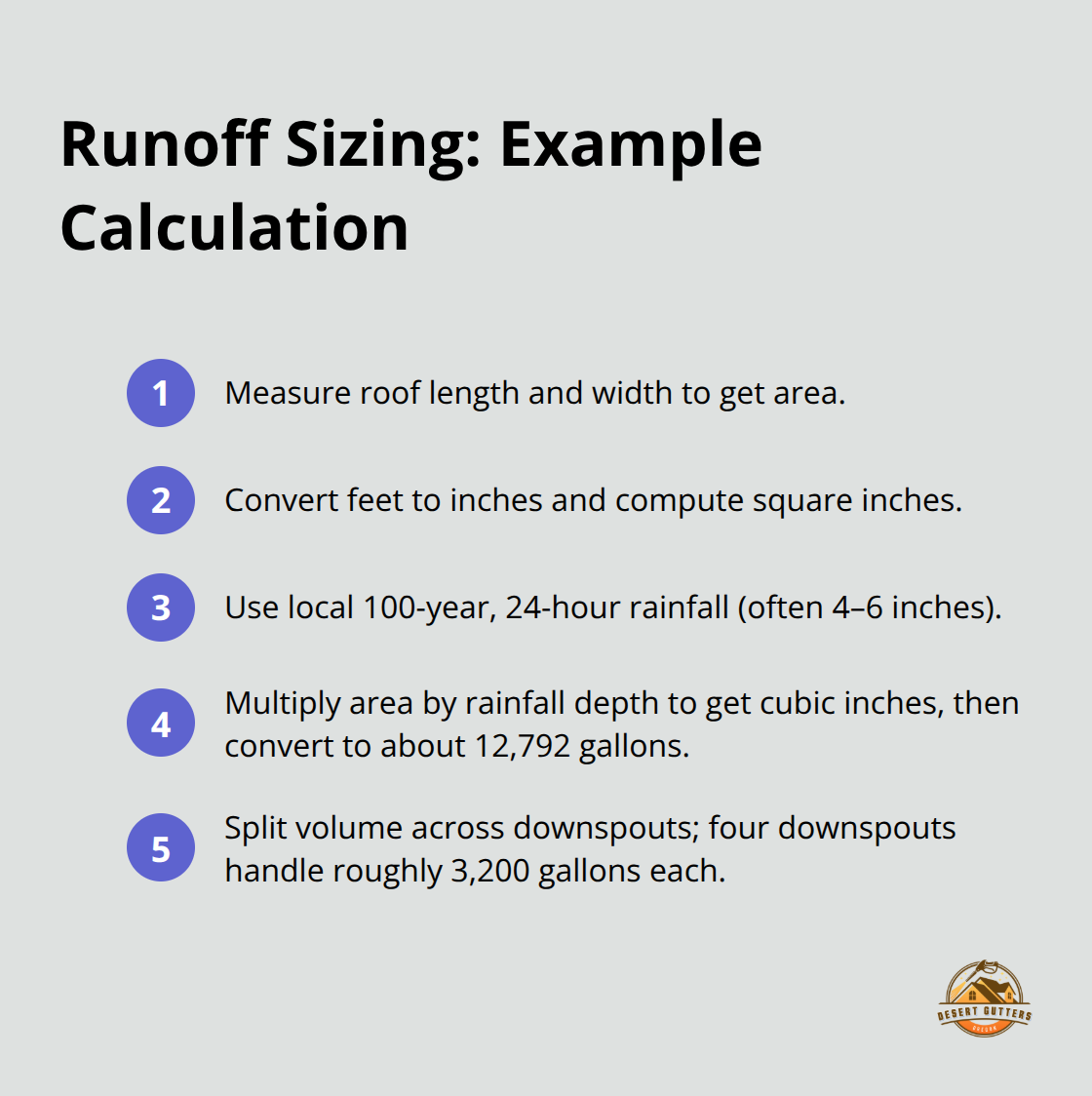
Start with your roof dimensions and local rainfall data, not guesswork. Measure your roof length and width in feet, then convert to square inches by multiplying each dimension by 12. For a 40 by 100 foot roof, that’s 480 inches by 1,200 inches, or 576,000 square inches. Next, find your area’s 100-year, 24-hour rainfall amount using data specific to your region. In many parts of the country, this ranges from 4 to 6 inches. Multiply your roof area in square inches by the rainfall depth in inches-so 576,000 times 5.13 inches equals roughly 2,955,000 cubic inches of runoff. Divide by 231 to convert to gallons, which gives you approximately 12,792 gallons of water your system must handle during an extreme rainfall event.
If you have four downspouts, each one needs to discharge roughly 3,200 gallons during that 24-hour period. This number drives everything else: pipe diameter, slope requirements, and outlet capacity. Without this calculation, you design blind, and blind designs fail during the storms that matter most.
Choose Underground Systems for Maximum Protection
Underground downspout systems outperform above-ground extensions for homes where foundation protection is the priority. A buried PVC or corrugated pipe run, sloped continuously away from your foundation at roughly 1 percent grade or steeper, moves water far enough away to eliminate hydrostatic pressure against foundation walls. Plan for a trench roughly 8 to 12 inches deep with a pop-up drainage emitter at the end, positioned at least 10 feet from the foundation and further if your yard slopes toward the house.
Solid PVC pipe resists clogging better than perforated options for underground runs. In cold climates, corrugated plastic pipe flexes with ground movement without cracking. Position your downspout outlets at least 4 to 6 feet from the foundation minimum, but 10 feet or more is standard practice for serious protection.
Position Outlets and Plan for Overflow
Above-ground extensions work only on level yards with good drainage and only when you maintain them actively-water sitting in a disconnected extension for weeks breeds mosquitoes and defeats the purpose. Your downspout positions must account for neighbors and property lines; discharge water toward a drainage easement or your own property, never directly onto adjacent land.
A catch basin at the end of the line, paired with a sanitary tee for overflow, handles heavy rain volumes and simplifies cleanout access when debris accumulates. This setup (combined with proper slope and pipe sizing) transforms your downspout system from a liability into a protective barrier for your foundation and landscape.
The next section addresses the specific mistakes that undermine even well-intentioned drainage plans-errors that turn a sound design into a source of water damage and costly repairs.
Common Downspout Drainage Mistakes
Position Outlets Far Enough From Your Foundation
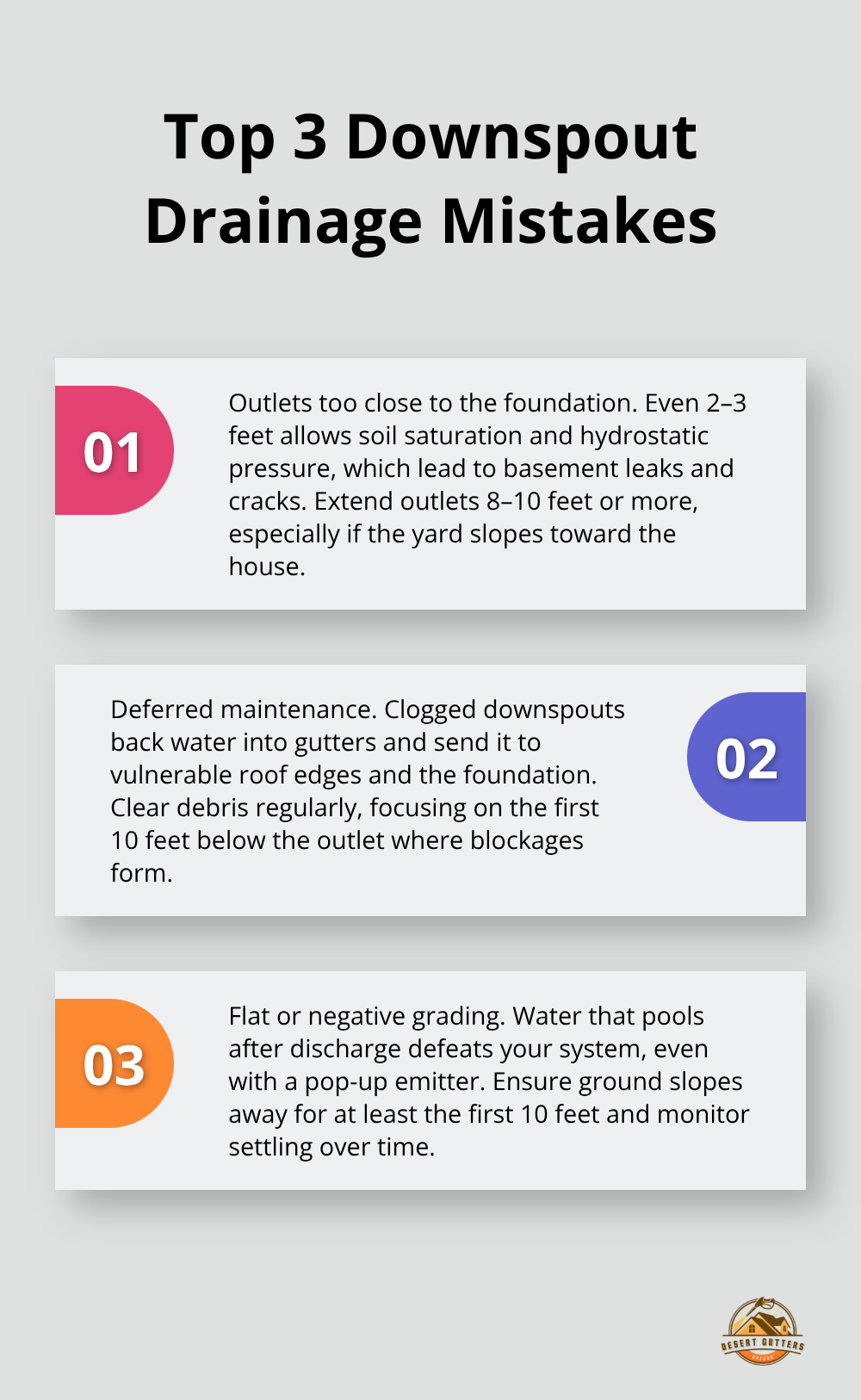
Most downspout failures trace back to three preventable errors that homeowners make during installation or maintenance. The first mistake happens at the design stage: positioning downspout outlets too close to your foundation. You need at least 4 to 6 feet of distance as an absolute minimum, but 8–10 feet is ideal for protecting your foundation from hydrostatic pressure. Many homeowners install downspouts, then extend them only 2 or 3 feet away because they think that’s far enough. It isn’t.
Water that discharges 3 feet from your foundation still saturates the soil immediately adjacent to your foundation walls, and that saturation leads directly to basement flooding and foundation cracks. If your yard slopes toward your house, you need even greater distance-sometimes 15 or 20 feet-because gravity works against you. Underground systems solve this problem completely: a buried PVC or corrugated pipe run sloped away at 1 percent grade moves water far enough to eliminate the risk entirely.
Maintain Your Downspouts Regularly
The second mistake is neglecting downspout maintenance, which undermines even well-designed systems. Clogged downspouts back water up into gutters, and backed-up water finds its way to vulnerable spots around your roof edge and foundation. Pine needles, leaves, and debris accumulate inside downspouts where you can’t see them, especially in the first 10 feet below the gutter outlet where the pipe transitions from steep to shallow slope.
You must inspect and clear downspouts at least twice yearly-once in fall after leaves drop and once in spring after winter debris settles. If you live in an area with heavy pine needle drop (like Central Oregon), more frequent clearing prevents blockages that turn minor drainage issues into major ones. This simple maintenance habit protects your entire system.
Verify Slope and Grading Away From Your Home
The third mistake is ignoring slope and grading. Your downspout outlet means nothing if water pools immediately after discharge because the ground is flat or slopes back toward your house. Grade the soil away from your foundation at a minimum slope over at least the first 10 feet, and verify that slope is maintained over time-settling and erosion flatten grades quickly.
A pop-up drainage emitter at the end of your downspout run only works if the ground slopes away from it; otherwise water backs up through the emitter and defeats its purpose. These three mistakes-poor outlet positioning, deferred maintenance, and flat grading-account for the vast majority of downspout failures. None of them require expensive equipment or professional expertise to fix; they require intentional planning and follow-through.
Final Thoughts
Proper downspout drainage planning protects your home by moving water away from the structures and soil that support it. Every calculation you make, every foot of distance you create between your downspout outlet and your foundation, and every maintenance cycle you complete adds years to your home’s lifespan and prevents the foundation cracks, basement floods, and erosion that plague homes with poor drainage. The $52,000 average cost of flood damage makes this planning not optional but essential.
Walk around your home and observe where water exits your downspouts during rain. Does it pool near your foundation? Does it carve channels in your landscaping? Does it discharge onto a neighbor’s property? These observations tell you whether your system works or fails, and they reveal whether your current outlets and grading meet the 4 to 6 foot minimum distance from your foundation. If they don’t, plan an upgrade.
A properly sized underground downspout system costs far less than repairing a cracked foundation or replacing a water-damaged basement, and regular gutter cleaning performed twice yearly costs nothing compared to the thousands you’ll spend on structural repairs if water reaches your foundation. If you’re uncertain about your system’s capacity or condition, contact Desert Gutters for a free estimate and let our local specialists evaluate your drainage needs and recommend solutions tailored to your home and climate.